
When ROAS drops, the first thing everyone touches is the campaign. Bids, budgets, audiences, asset groups. Sometimes that is the problem.
Across 700+ accounts, more often it is not.
The campaign is doing its job. It is putting your product in front of someone who is actively shopping for it. What happens next is decided by the listing, and most stores have never audited theirs.
The part of the funnel nobody optimizes
A Shopping or Performance Max campaign is fed almost entirely by your product data. The title, the description, the image, the attributes. Google reads that feed to decide when to show your product and who to show it to. The shopper then reads the same data to decide whether to click.
Two different jobs, same asset. Most stores optimize it for neither.
Here is what that looks like in a live account.
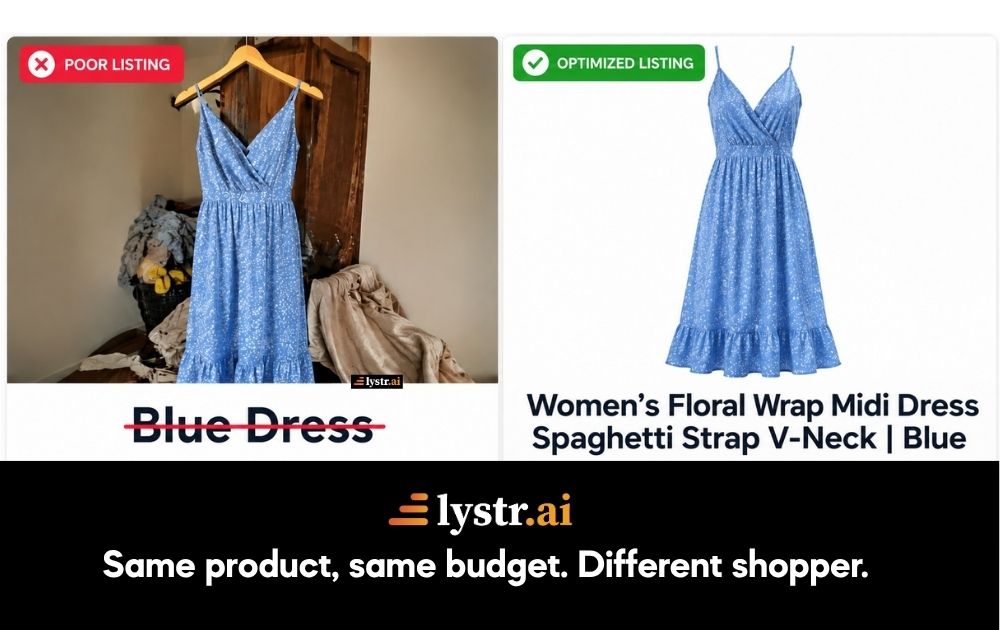
Weak title: Blue Dress
Optimized title: Women's Blue Midi Wrap Dress, Short Sleeve, Cotton, Summer
The first title gives Google almost nothing to match against. It will surface for broad, low-intent queries and burn budget on clicks that were never going to convert. The second contains attributes that map to how people actually search: gender, colour, length, style, sleeve, material, season.
Same product. Same campaign. Completely different query matching.
Where the money leaks
1. Titles that do not match search intent
Google Shopping relies heavily on title matching. A title missing key attributes competes for the wrong queries. Your impressions look healthy, your CTR looks acceptable, and your conversion rate quietly sits at a third of what it should be, because the traffic was mismatched at the source.
2. Descriptions written for nobody
Supplier-copied descriptions are duplicated across dozens of stores selling the same item. They rarely answer the questions that decide a purchase: fit, materials, sizing, care, what is in the box. When the description does not close the objection, the shopper leaves to find one that does, often on a competitor's page.
3. Images that undercut the ad
Shopping ads are visual. A product shot against a cluttered background, lit badly, or inconsistent with the rest of your catalogue loses the impression battle before the shopper reads a single word. In a grid of competing results, image quality is the first filter, and it is applied in under a second.
4. Feed data that triggers disapprovals
Poor listing data does not just cost performance, it costs account health. Mismatched attributes, missing information, and inconsistent product data are a common route to Merchant Center suspension. We covered the most frequent version of that problem in Google Merchant Center Misrepresentation: Why Shopify Stores Get Suspended. https://adontechnologies.com/blog/google-merchant-center-misrepresentation-shopify-fix
Why most stores never fix it
Not because they disagree. Because of the arithmetic.
A store with 300 SKUs needs 300 rewritten titles, 300 rewritten descriptions, and in most cases a full reshoot. Priced conventionally that is a copywriter, a photographer, a studio day, and weeks of turnaround. For a store still proving its unit economics, that spend is impossible to justify against a campaign budget that needs feeding this month.
So the listings stay as they are, the campaign gets optimized again, and performance stays capped by the asset nobody touched.
Fixing the asset before you fund the traffic
This is the problem we built Lystr.ai to solve. https://lystr.ai
Lystr.ai is an AI product listing platform for Shopify. It imports a product from a link or a photo, generates a search-optimized title and a description written to convert, creates AI model photography and clean product imagery without a studio, and publishes the finished listing straight back to Shopify.
What used to take a team and a fortnight takes minutes per product. For stores running paid traffic, that changes the sequence. You fix the asset first, then fund it, instead of paying to send shoppers to a page that was never going to convert them.
The tool is free to start with 100 credits and no card required.
The check worth running this week
Open Google Ads, sort your products by spend, and take the top twenty.
For each one, ask three questions:
Does the title contain the attributes a shopper would actually type?
Does the description answer the objection that stops the sale?
Would the main image win in a grid against four competitors?
Whatever fails those three is not a campaign problem. No amount of bid strategy fixes a listing that cannot convert.
Fix the listing first. Then scale the spend.
Running paid traffic and want the listings audited properly? Talk to Adon Technologies. https://adontechnologies.com/contact-us
Want to fix them yourself, at scale? Start free on Lystr.ai. https://lystr.ai